If you sell clothing online, you've probably seen product photos where a garment looks like it's floating with a natural, filled-out shape — no model, no visible mannequin, no wrinkled hanger shot. That effect is ghost mannequin editing, and the hardest part of getting it right is almost always the collar — a step called neck join. The two terms get used interchangeably in casual conversation and even show up as separate line items on the same invoice, which leads a lot of sellers to assume they're competing techniques you have to choose between. They're not — but knowing how they relate to each other still affects what you order and what you pay.
What Is Ghost Mannequin Photography?
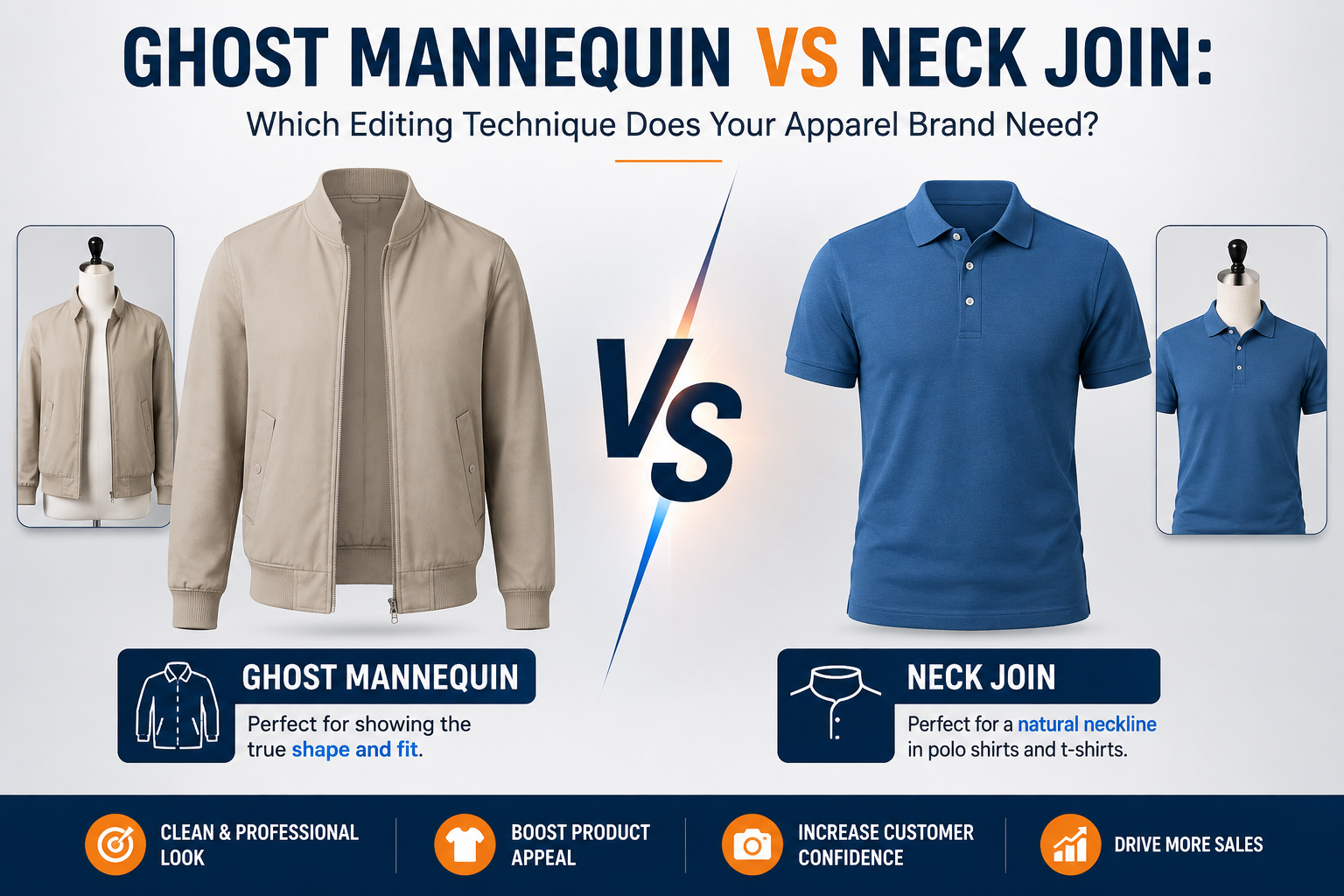
Ghost mannequin — also called invisible mannequin or 3D mannequin effect — is a full-garment editing technique. The garment is shot on a real mannequin from multiple angles (front, back, sometimes the interior neckline through a partially undressed shot), and an editor combines those shots into one clean image. The mannequin is digitally removed entirely, leaving a garment that looks three-dimensional, symmetrical, and worn — without anyone actually wearing it. See our full breakdown of the ghost mannequin editing service for examples.
This technique is the industry standard for:
- T-shirts, hoodies, and jackets that need to show volume and drape
- Dresses and tops where the collar and shoulder shape matter to the buyer
- Any listing where a flat-lay photo would make the garment look lifeless or shapeless
What Is Neck Join?
Neck join is the specific step inside a ghost mannequin edit that blends the inside of the collar with the outside of the garment, so the neckline reads as hollow and three-dimensional instead of looking like two photos pasted together. It's the trickiest part of the whole edit, which is why it's often priced and discussed as its own thing. See our neck join editing service for examples.
Because it's a distinct step, neck join can also be ordered on its own — not just as part of a full ghost mannequin job:
- You've already had the mannequin removed elsewhere and just need the collar/neckline blended cleanly
- You're re-editing an older batch of images where only the neckline looks unnatural
- Your garment shots are otherwise finished and you only need the collar composite fixed or redone
The Core Difference
Ghost mannequin is the full, end-to-end technique — shooting a garment on a mannequin from several angles and compositing it into one invisible-mannequin image. Neck join is the specific collar-blending step inside that process, and the one most likely to look wrong if it's rushed. Most sellers order them together as a single job; neck join alone only makes sense if the rest of the mannequin-removal work is already done.
How to Decide What to Order
| Situation | What to Order |
|---|---|
| Starting from raw mannequin shots, nothing edited yet | Full Ghost Mannequin |
| Mannequin already removed elsewhere, collar still looks off | Neck Join (standalone) |
| You want natural drape, fit, and volume without a person | Full Ghost Mannequin |
| Only the neckline/collar area needs redoing | Neck Join (standalone) |
| Structured garments (blazers, dresses, outerwear) from scratch | Full Ghost Mannequin |
Why This Matters for Amazon, Shopify, and Etsy Sellers
Marketplace guidelines increasingly reward clean, consistent product presentation. Amazon's main listing image requirements favor a pure white background and a garment that reads clearly at a glance — ghost mannequin editing typically performs better here. Shopify and independent stores have more creative freedom but still benefit from a natural, seamless neckline once a garment is shown mannequin-free. Etsy sellers working with handmade or vintage apparel often use the full ghost mannequin technique to keep focus on construction details like stitching, texture, and fit.
Ordering the right thing upfront also affects cost and turnaround. A full ghost mannequin edit requires multiple source photos per garment (often 3-5 angles) and more complex compositing, so it typically costs more per image than neck join alone, which works from images that are already mostly finished.
Common Mistakes Brands Make
- Requesting a full ghost mannequin edit without shooting the interior/neckline angle — editors need that extra shot to build a convincing 3D effect and a clean neck join. Without it, the collar area often looks flat or unnatural. Our guide to shooting for ghost mannequin and neck join covers exactly which angles to capture.
- Paying for a full ghost mannequin re-edit when only the collar needs fixing — if the mannequin removal already looks fine and just the neckline reads unnatural, ordering neck join alone is faster and cheaper than redoing the whole image.
- Mixing edit quality within the same catalog inconsistently — buyers notice when some listings have a clean, seamless neckline and others look pasted together. Keep the same standard across a product category.
The Bottom Line
Ghost mannequin and neck join aren't competing techniques — neck join is the collar-blending step inside a ghost mannequin edit, and it's the one most worth getting right. Most sellers order the full technique together; neck join on its own is for touch-ups and fixes once the rest of the image is already done. For a deeper look at how manual editing compares to automated tools for this exact technique, see our manual vs. AI ghost mannequin comparison.
Not sure whether you need the full ghost mannequin service or just a neck join fix, or want a free sample edit to see the result on your own garment? Get in touch with PixelTrim Studio — we handle both ghost mannequin and neck join editing for apparel brands selling on Amazon, Etsy, and Shopify.
Tags
Ready to get your images edited?
Upload 2 photos for a free trial edit — returned in under 24 hours.
Start free trial →