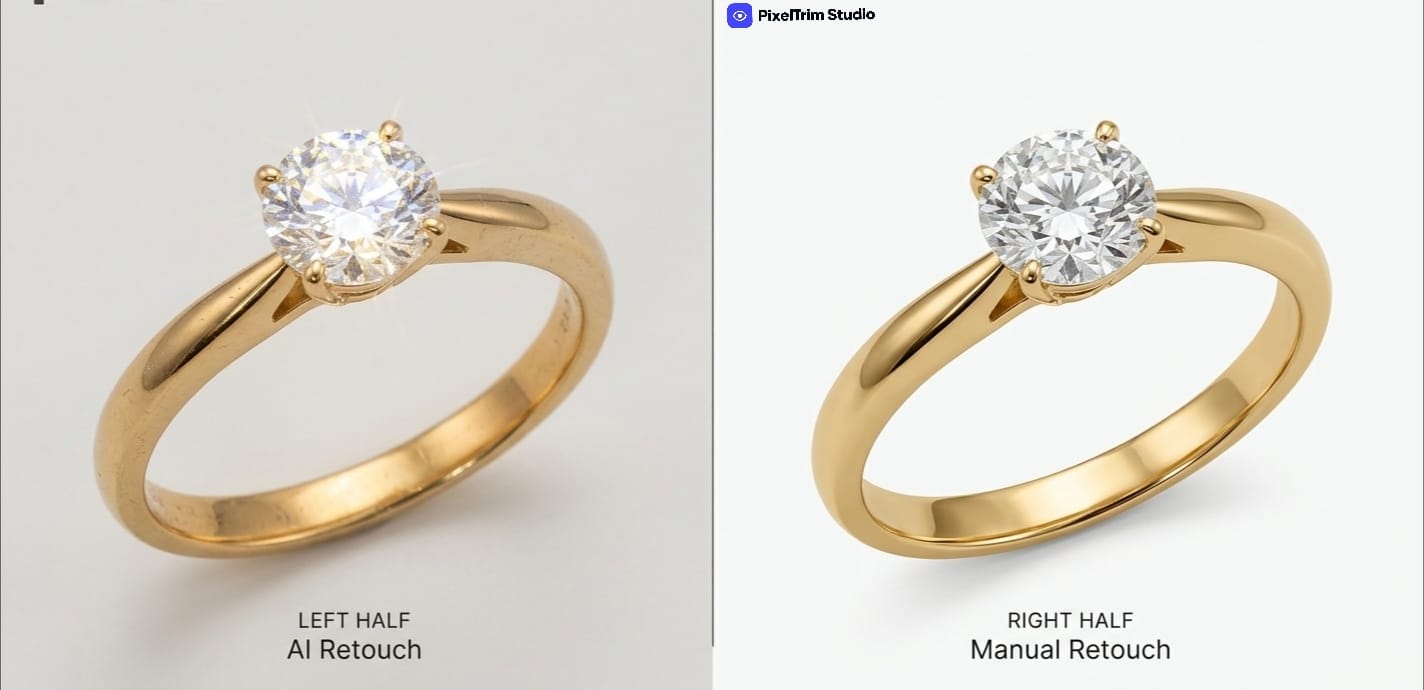
If you sell jewelry online, you've probably seen an AI "auto-enhance" tool promise instant sparkle on a ring or necklace photo in five seconds. It sounds tempting — until the gemstone looks artificially blown out, the metal tone shifts warm, and the dust on the setting is still sitting right there. So does AI jewelry retouching actually hold up for a real listing, or are you still going to need a human editor before it's publish-ready?
Here's an honest, image-by-image breakdown.
What Is Manual Jewelry Retouching?
Manual jewelry retouching is when a trained editor works on a piece by hand — usually at 200%+ zoom — to remove dust, scratches, and fingerprints from metal surfaces, correct true gold/silver/rose gold color, and enhance gemstone sparkle without making it look fake. We've covered the full process and pricing in our jewelry retouching cost guide.
What Is AI Jewelry Retouching?
AI jewelry retouching tools run an automated filter over the image — sharpening edges, boosting saturation, and attempting to "clean" the surface algorithmically. No human editor reviews the piece at zoom level. It's instant and often free, which is exactly why it's tempting for a quick catalog update.
Where AI Jewelry Retouching Falls Short
- Fake-looking sparkle — AI tools tend to oversaturate gemstone facets or add artificial glow instead of enhancing the piece's real highlights, which reads as fake to a buyer who's paying a premium price.
- Missed micro-detail — dust, lint, and fine scratches that only show up at high zoom are exactly what automated filters skip over, since they're not "detecting" a flaw, just applying a blanket sharpen/saturate pass.
- Metal color drift — gold, silver, and rose gold have very close tonal differences; AI color correction often shifts one toward another, which is a real problem when the listing needs to match the actual piece.
- Reflective and transparent surfaces — polished metal and faceted gemstones confuse automated background and surface tools, often leaving halos or flattened reflections that look unnatural.
- Wire and string removal — floating jewelry shots held by invisible thread need that thread manually painted out; AI tools frequently leave a faint ghost line behind.
Where AI Jewelry Retouching Actually Works Fine
For a quick internal preview, a social media draft, or a low-stakes mockup where the piece isn't the focus, an AI filter can save time and looks passable at a glance. For anything that isn't a final, purchase-driving listing image, that's often good enough.
Why Manual Jewelry Retouching Still Wins for Listings
Jewelry is one of the highest scrutiny product categories online — buyers zoom in, compare metal tones across multiple photos, and expect the piece to look exactly as described. This is the same reason manual clipping path still wins over AI background removal and manual ghost mannequin editing beats AI tools for listing-ready apparel images — hand work catches what an algorithm approximates. Manual jewelry retouching gives you:
- Micro-detail cleanup at 200%+ zoom — scratches, dust, and fingerprints actually removed, not just softened
- True metal and gemstone color correction, not an algorithm's approximation
- Sparkle and facet enhancement that still looks like a photograph, not a filter
- Clean wire and string removal on floating or suspended pieces
Cost and Speed: The Honest Trade-off
AI retouching is free or near-free and instant. Manual jewelry retouching costs more and takes longer because a real editor is working the piece by hand — starting around $1.99 per image for basic dust and lint cleanup, scaling up for full surface polish and sparkle enhancement. See the jewelry retouch service for the full pricing tiers, or the broader jewelry retouching cost breakdown for what drives the price up or down. For a piece that sells at a premium, that cost difference is usually smaller than the cost of a return triggered by a listing photo that didn't match the real item.
Which Should You Choose?
If the photo is going on a live listing, your website, or anywhere a buyer is making a purchase decision based on it, go manual. If you just need a rough version for an internal mood board or a quick social teaser, an AI filter can save time. Many jewelry sellers use both — AI for a fast first look, manual retouching for the final image that actually goes live. For a broader look at where AI genuinely helps versus where it still falls short across product photo editing overall, see Manual vs AI Photo Editing.
Getting the shot right in the first place also cuts down on how much retouching is needed at all — see our jewelry photography tips for shooting pieces that are easier and cheaper to edit. And if your jewelry has fine, complex edges that need isolating first, our guide on what clipping path actually is covers the cutout step that often comes before retouching.
FAQ
Can AI jewelry retouching handle dust and micro-scratches?
Usually not reliably. AI filters apply a blanket sharpen or saturate pass rather than reviewing the piece at zoom level, so fine dust, lint, and scratches often get missed. Manual retouching catches these because an editor is working at 200%+ zoom.
Does AI retouching get gold, silver, and rose gold colors right?
Not consistently. These metal tones are close enough that automated color correction frequently drifts one toward another. Manual retouching corrects each piece's true metal tone individually.
Can AI remove the wire or string from a floating jewelry shot?
Rarely cleanly. AI tools often leave a faint ghost line where the thread was. Manual editors paint this out by hand as a standard part of jewelry retouching.
Is AI jewelry retouching ever good enough?
For a quick internal preview or a low-stakes social draft, yes. For a final image going on a live listing or your website, manual retouching is the safer choice given how closely jewelry buyers scrutinize photos.
How much does manual jewelry retouching cost compared to AI tools?
AI retouching tools are typically free or near-free. Manual retouching starts around $1.99 per image for basic cleanup and scales up with the level of polish and enhancement needed — see the full pricing breakdown for exact tiers.
Want to see the difference on your own jewelry photos? Get a free sample edit from our team and compare it yourself.
Tags
Ready to get your images edited?
Upload 2 photos for a free trial edit — returned in under 24 hours.
Start free trial →