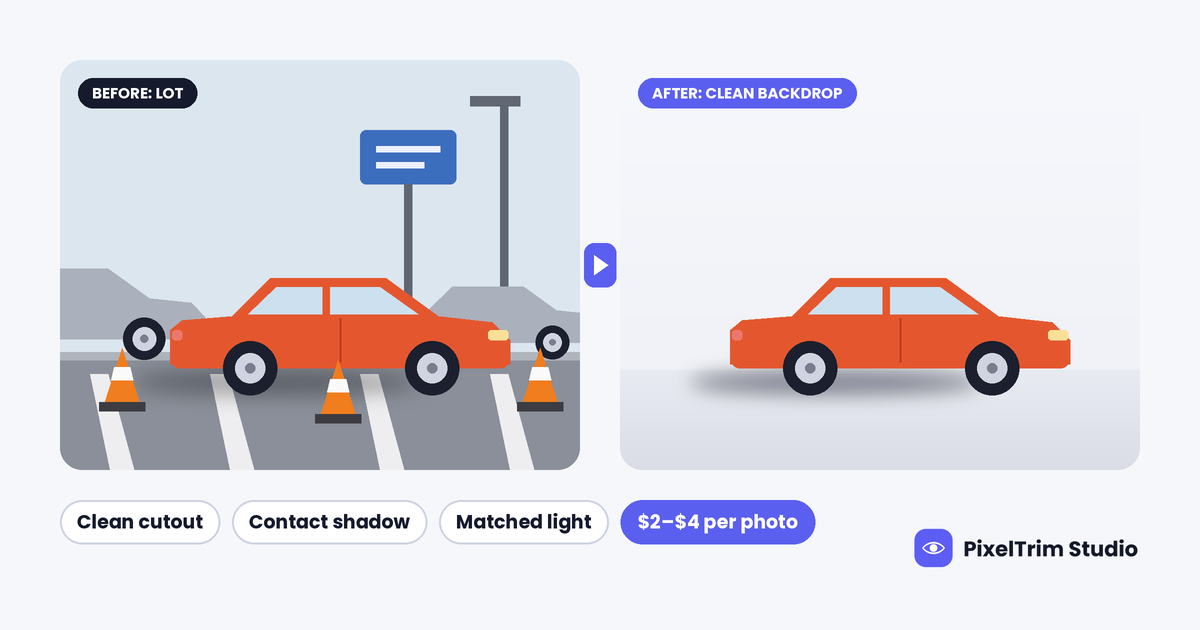
A dealership lot is a poor photo studio. Cones, light poles, neighboring cars and a different patch of asphalt end up behind every vehicle. Car background replacement swaps all of that for one clean backdrop, so forty cars on your site read as one consistent showroom. It sounds like a simple cutout, but a car is one of the hardest subjects to cut out well. This guide covers what the edit really involves, where it goes wrong, what it typically costs, and what to check before you send a batch to a car retouching service.
What Car Background Replacement Actually Involves
It is four jobs, not one:
- Cutout. The vehicle is separated from the lot, including the gaps between spokes, around mirrors and behind door handles.
- New backdrop. A studio, gradient, showroom or branded backdrop is placed behind the cutout.
- Grounding. A contact shadow goes under the tires, and a soft floor reflection is added if the backdrop calls for one, so the car sits on the surface instead of floating above it.
- Matching. Brightness, color temperature and floor tone are adjusted so the car and the backdrop look like one photo.
Skip steps three and four and the cutout can be perfect while the image still looks pasted. Most fake-looking dealership photos fail there, not at the edge.
Backdrop Styles Dealers Use
| Backdrop style | Works well for | Watch for |
|---|---|---|
| Plain white or light grey | Large used inventory where uniformity matters | Light paint can lose its edge against a light floor |
| Dark or gradient studio | Premium and performance vehicles | Dark paint needs a visible edge highlight to avoid blending in |
| Branded dealer backdrop | Franchise sites that want one recognizable look | Needs a fixed template, or every car ends up slightly different |
| Realistic outdoor or showroom scene | Lifestyle and social images | Perspective, light direction and shadow all have to match |
The Parts of a Car That Break a Cutout
Wheels and spokes
The gaps between spokes and behind the wheel arch should show the new backdrop, not the old lot. A patch of asphalt left inside a rim is an easy sign that the edit was rushed.
Glass
Glass sits between two worlds: you see the cabin, and through the far windows you see whatever is behind the car. A flat fill makes the interior look painted on, while leaving the old lot visible through the rear window gives the swap away.
Mirrors, antennas and roof rails
Thin parts are where rough cutouts leave a light fringe of the old background. Zoom in on these first when you check a sample.
Where the tire meets the ground
The contact shadow starts here. If it is missing or too light, the car looks like a sticker no matter how clean the rest of the edge is.
Why a New Background Can Still Look Fake
Replacing the background does not change what is reflected in the paint and glass. A car shot on a lot carries reflections of trees, buildings and neighboring vehicles on its glossy panels. Drop it onto a clean studio floor and those reflections describe an environment that is no longer there. Cleaning them up is a separate job from the swap, which is why tools that only replace the backdrop often leave the lot behind in the paint. Our manual vs AI car photo editing comparison shows where automated tools tend to struggle on reflective surfaces.
Keeping a Full Set Consistent
A listing usually carries 15–25 photos per vehicle, and the set should look like one shoot. Whoever edits it should hold these constant across every angle and every car:
- Backdrop color and floor tone
- Floor line height, so the horizon does not jump between photos
- Shadow direction and softness
- Cutout quality, including the same edge treatment on wheels and glass
Sets that drift from photo to photo look like the work of several editors. Consistency starts at the shoot: a locked camera height, distance and angle set make the edit faster, as our car photography tips explain. For the sales side of a uniform look, see how photo editing sells cars faster.
What Car Background Replacement Costs
| Edit | Typical price | What affects it most |
|---|---|---|
| Background cleanup / lot removal | $1.00–$2.50 per image | Clutter level, number of vehicles in frame |
| Full background replacement (studio or gradient) | $2.00–$4.00 per image | Edge complexity around mirrors, wheels and handles |
| Full listing set (15–25 photos, all fixes) | $25–$60 per vehicle | Bundled rate vs per-image billing |
These are general market ranges, not fixed quotes. The full breakdown by edit type is in our car photo editing cost guide. At PixelTrim Studio every image is edited by hand, turnaround is 24–48 hours and one free revision is included. You can send 2 photos for a free trial edit, returned in under 24 hours, before you commit a batch.
When You Do Not Need Replacement
If your lot shots are already taken against a clean wall or empty pavement, background cleanup may be enough, and it sits at the lower end of the price range above. Interior and close-up detail shots usually need no new backdrop at all.
Checklist Before You Order
- Ask for a sample on your own car, not a showroom demo.
- Zoom into wheels, mirrors and the antenna and look for leftover lot.
- Check the ground: every tire should have a contact shadow.
- Look at paint and glass for reflections of the old lot.
- Compare two angles of the same car for a matching floor line and shadow direction.
- Confirm turnaround, revision policy and output formats before the batch starts. Our car photo editing services guide has the full provider checklist.
Frequently Asked Questions
Is car background replacement the same as background removal?
No. Background removal cuts the car out and leaves a transparent or plain white area. Background replacement also adds a new backdrop, a contact shadow under the tires, and light and color matching so the car looks like it was shot there.
How much does car background replacement cost?
Typical market ranges are $2.00–$4.00 per image for a full studio or gradient replacement, and $1.00–$2.50 for simple background cleanup. A full listing set of 15–25 photos with all fixes usually runs $25–$60 per vehicle. These are general ranges, not fixed quotes.
Why does my car look pasted onto the new background?
Usually one of three things: there is no contact shadow under the tires, the lighting on the car does not match the backdrop, or the paint and glass still reflect the old lot. Fixing all three makes the car sit on the floor instead of floating above it.
Can AI tools replace car backgrounds well enough for listings?
AI tools handle simple swaps on clean, uncluttered shots reasonably well. They tend to struggle with wheel gaps, glass, reflections on paint and consistency across a full set, so live listings usually need a manual pass.
Do interior photos need a background replacement?
No. Interior shots have no outdoor backdrop to swap. They usually need exposure, color and window-view correction instead.
Want to See It on Your Own Inventory?
Send two sample photos and we will edit them for free so you can judge the cutout, the shadow and the reflections yourself. See our car retouching service for what is included.
Tags
Ready to get your images edited?
Upload 2 photos for a free trial edit — returned in under 24 hours.
Start free trial →