Dealerships and marketplace sellers are the newest target for "instant" AI photo tools — upload a raw lot photo, get a studio-clean listing image back in seconds. It sounds like the end of paying for car retouching. But paint, glass, and chrome are some of the hardest surfaces to edit accurately, and that's exactly where most AI tools start cutting corners. Here's an honest, panel-by-panel breakdown of where AI car photo editing actually holds up — and where it still costs you a sale.
What Is Car Photo Editing, Manual or AI? (Quick Recap)
Car photo editing covers background cleanup, glare and reflection removal, color and paint accuracy correction, wheel and trim cleanup, sky replacement, and HDR blending for interior shots. We've covered the full list of what's included in our car photo editing services guide. The question here isn't what gets edited — it's who (or what) does the editing, and whether the result is good enough to publish.
What AI Car Photo Editing Tools Actually Do Well
- Fast, flat background swaps on vehicles shot against a plain, low-clutter backdrop
- Basic brightness and contrast auto-correction on underexposed lot shots
- Bulk processing — hundreds of images in minutes, no editor queue to wait on
- Very low cost per image at high volume, which matters for 500-car dealership batches
Where AI Car Photo Editing Falls Short
Cars are one of the toughest product categories for AI models to edit accurately, mainly because reflective surfaces don't behave like flat product backgrounds.
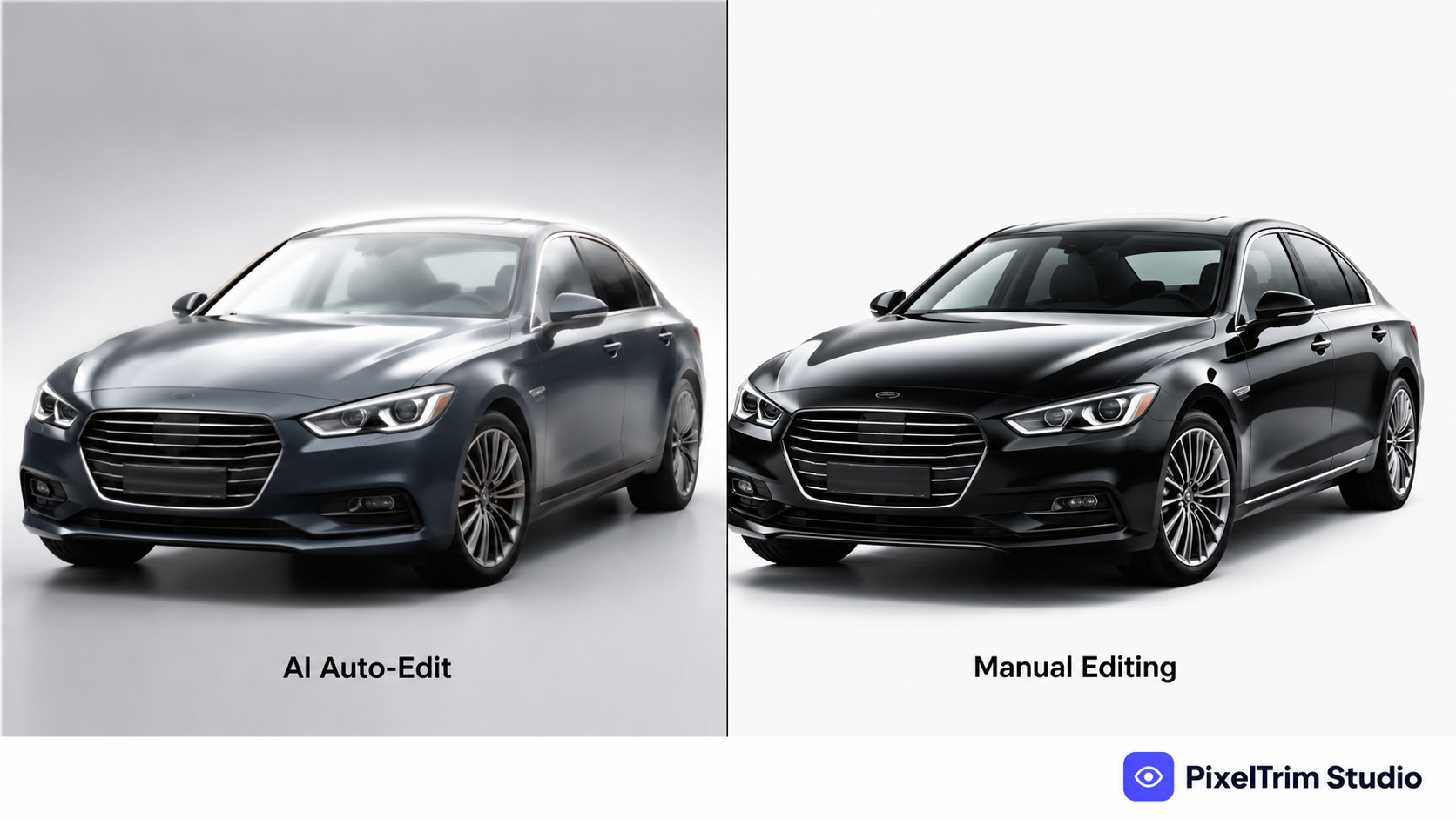
- Glare and reflection removal — AI models tend to either leave reflections untouched or over-smooth them, flattening the paint's natural shine until the car looks plastic or matte instead of clean.
- Paint color accuracy — a "Midnight Blue" or "Champagne" trim shifted toward gray under bad lot lighting is a common AI miss, since auto color-correction is generic and not calibrated to the actual paint code. This is the same trust gap covered in our guide to product color accuracy and return rates.
- Wheel, rim, and chrome trim cleanup — brake dust, scuffs, and glare on curved chrome surfaces need selective, hand-guided correction; AI tools frequently blur or oversharpen these small detail areas instead of cleaning them.
- HDR blending for interiors — dashboard shots through a windshield need multiple exposures blended so both the cabin detail and the outside view are visible. Most AI "auto-enhance" tools work from a single exposure, so they can't recover blown-out windows the way true HDR blending does.
- Consistency across a full lot — one photo comes out clean, the next from the same batch has a warped reflection or mismatched color temperature, which is hard to catch at scale without a human reviewing every image before it goes live.
Where AI Car Photo Tools Work Fine
For quick internal previews — checking a shot is usable before a full edit, or a fast social media teaser post — AI auto-enhance is genuinely useful. It's also passable for simple background swaps on matte-finish commercial vehicles or fleet trucks with minimal reflective panel area. For anything going live on a paid listing, treat AI output as a rough draft, not a final image.
Manual vs AI Car Photo Editing: Side-by-Side
| Factor | Manual Editing | AI Editing |
|---|---|---|
| Glare & reflection removal | Accurate, selective | Inconsistent, often over-smoothed |
| Paint color accuracy | Matched to real paint tone | Generic, frequently off |
| Wheel & chrome detail | Cleaned without blurring | Often blurred or oversharpened |
| Interior HDR blending | True multi-exposure blend | Rarely true HDR |
| Consistency across a lot | High, checked image by image | Variable batch to batch |
| Turnaround per image | Slower (24–48h typical) | Seconds to minutes |
| Cost per image | Higher | Lower |
| Best for | Live listings, dealership inventory | Quick previews, low-stakes drafts |
Cost and Speed: The Honest Trade-off
AI editing is close to free and near-instant, which is genuinely appealing for a 300-car lot. But manual car photo editing isn't priced the same as flat product photography either — most editors quote a flat per-vehicle rate once you're past a handful of photos, since color and lighting settings carry across the same shoot. For exact price ranges by edit type, see our car photo editing cost guide, or compare against other categories in the product photo editing pricing guide.
Why This Matters More for Cars Than Most Product Categories
A buyer decides whether to click into a listing within seconds, and reflections, mismatched color, or a dull interior shot are exactly the kind of small flaw that makes a clean car look untrustworthy in a photo. We break this down further in how photo editing sells cars faster — the short version is that AI's inconsistency across a batch is a bigger risk here than in most product categories, because a dealership is publishing 15–25 photos per vehicle, and it only takes one bad reflection or off-color panel to undercut the whole set.
Which Should You Choose?
If the photo is going live on a dealership website, Cars.com, AutoTrader, or Facebook Marketplace, go manual — glare, paint accuracy, and interior HDR are too easy for AI to get wrong, and buyers notice. If you just need a fast internal check of a shot before deciding whether to keep it, AI auto-enhance is fine for that narrow use. Many dealerships land on a hybrid: AI for a quick first look at raw lot photos, manual editing for everything that actually goes live.
Frequently Asked Questions
Is AI car photo editing good enough for dealership listings?
Usually not on its own. Reflective paint, chrome, and interior HDR blending are exactly where AI tools tend to struggle, and a dealership publishing 15–25 photos per vehicle can't afford one inconsistent image undercutting the set.
Can AI tools fix glare and reflections on car paint?
Partially. AI can reduce overall brightness or contrast, but selective reflection removal that preserves the paint's natural shine still needs a trained editor working the specific reflective area by hand.
Does AI photo editing work for fleet or commercial vehicles?
Better than for glossy retail vehicles, since fleet trucks and vans often have matte finishes and less reflective surface area. It still won't match manual editing for interior shots or color-critical listings.
Is manual car photo editing worth the extra cost over AI?
For live listings, yes — the cost difference is usually smaller than the cost of a listing that underperforms because of glare, an off-color paint shot, or a flat, dark interior photo.
Can manual and AI editing be combined for a dealership batch?
Yes. A common workflow uses AI for a fast first-pass check on raw lot photos, then manual editing for the final images that actually go live on listings.
Want to see the difference on your own inventory photos? Get a free sample edit from our team and compare it yourself.
Related Reads
- Car Photo Editing Services: What's Included and How to Choose a Provider
- Car Photo Editing Cost: What Dealerships & Sellers Actually Pay
- Manual vs AI Photo Editing: Which One Actually Gives You Better Product Photos?
- Manual Ghost Mannequin Editing vs AI Tools: Which Wins?
- Manual Clipping Path vs AI Background Removal
- Manual Vector Tracing vs AI Vectorization: Which One Actually Wins
Tags
Ready to get your images edited?
Upload 2 photos for a free trial edit — returned in under 24 hours.
Start free trial →