An AI-generated product photo can be legal on one marketplace, need a metadata tag on another, and be unacceptable as a main image on a third. Recently the rules have split into separate layers: platform policy, file metadata, advertising law and, for sales into Europe, the EU AI Act. This guide sorts them by platform, flags where sources contradict each other, and shows what ordinary photo editing does not need labeled.
Quick Answer: What Needs a Label?
The labels are aimed at generated content, not at editing a real photograph. Here is how the common cases line up:
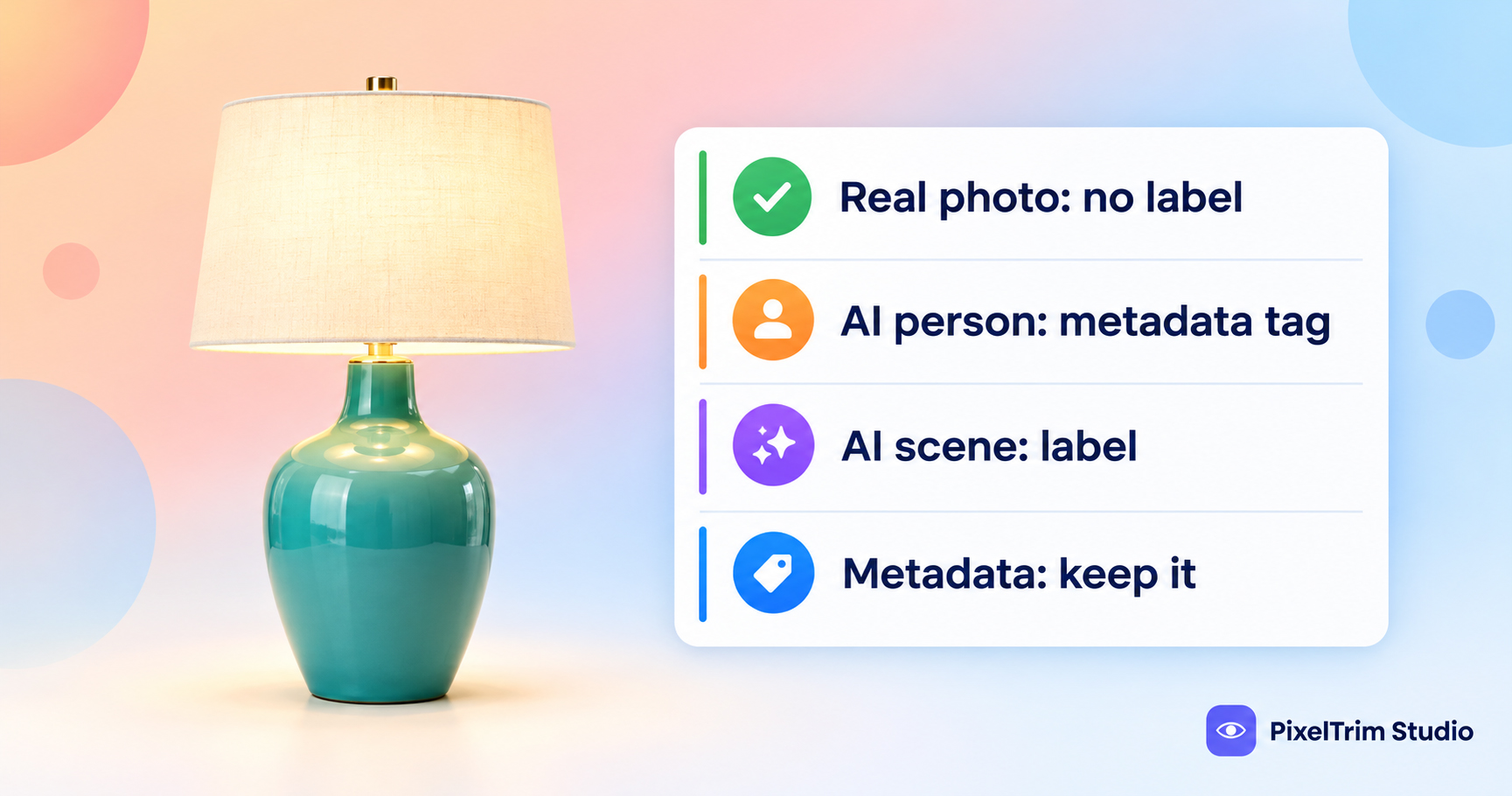
| What was done to the image | Label or tag needed? |
|---|---|
| Cutout, background removal, color correction or cleanup on a real photo | Generally no. These rules target synthetic content, not routine editing. |
| AI-generated or AI-swapped scene or backdrop | Depends on the platform. TikTok Shop and Google Merchant Center both have rules, covered below. |
| Photorealistic AI-generated person (model or bystander) in a listing image | Yes on Amazon, as a metadata tag. Also a disclosure issue for ads under New York law and on TikTok Shop. |
| Fully AI-generated image standing in for the real product | Not a labeling question. Amazon and Etsy expect images of the actual item, and TikTok Shop is reported to bar digital renderings of a product, so a label does not rescue it. |
Platform by Platform: The Current Rules
Several of these rules live inside login-gated seller portals, so each row shows where the information comes from and how much to trust it.
| Platform | What it requires | Source and confidence |
|---|---|---|
| Amazon | Listing images, A+ content and video that contain photorealistic people generated entirely by AI need a metadata keyword before upload. Fictional characters and real people edited with AI are excluded. Amazon also plans a shopper-facing indicator but has not published when it appears. Main image rules (pure white, 85% fill, 1,000 px minimum) are unchanged. | Recent seller notice, reported by Forbes citing CNBC. Amazon's own page is login-gated. |
| Etsy | Items created from a seller's own AI prompts are listed as "Designed by a seller," with AI use disclosed in the listing description. Listing photos must be your own photographs, not stock images or artistic renderings, and must show the item accurately. | Etsy Creativity Standards and Seller Policy (public pages). High confidence. |
| TikTok Shop | Substantially AI-generated or AI-altered content needs a disclosure. Routine cleanup does not. Reports differ on whether a fully synthetic product render is banned outright. | Seller Academy policy is gated. Summarized by third parties and Forbes. Medium confidence. |
| Google Merchant Center | Images created with generative AI must contain the IPTC DigitalSourceType value for trained algorithmic media, and the embedded metadata must not be stripped. Google's original notice applied this to the image_link, additional_image_link and lifestyle_image_link attributes. | Google Merchant Center Help (public). High confidence. |
| Meta ads (Facebook and Instagram) | AI-generated or substantially AI-modified ad creative needs Meta's AI label, applied in Ads Manager. | Third-party summaries. Confirm in Ads Manager. |
| eBay and Walmart | No image-specific AI label rule found. Accuracy rules still apply, including a real photo of the actual item where the platform asks for one. Some blogs claim stricter rules, but we found no primary source for them. | Third-party roundups. Confirm in each seller portal. |
| European Union | The AI Act's Article 50 transparency duties now apply. Anyone publishing AI-generated or manipulated images that realistically resemble real people, objects, places or events must label them. Providers of generative tools that were already on the market get a short transition period to add machine-readable marking. Fines can reach EUR 15 million or 3% of worldwide turnover. | EU AI Act and the Commission's published guidelines, via law-firm summaries. |
| US states | New York's synthetic performer law requires conspicuous disclosure when an advertisement contains a synthetic performer. Penalties start at $1,000 and rise to $5,000 per later violation, and synthetic background figures count. California's AI Transparency Act amendments (AB 853) are phasing in, with large-platform duties arriving in a later stage. | Forbes summary of the statutes. |
This is a seller's summary, not legal advice. Whether a realistic AI product scene counts as a deepfake under the EU Act is still a grey area, so commentators generally treat labeling as the safe choice.
Where Sources Disagree
Search any of these rules and you will find guides that contradict each other. Four conflicts matter:
- Amazon: blanket mandate or people only? A few blog posts describe a label requirement for every AI-edited product image. The seller notice as reported by Forbes covers photorealistic AI-generated people. We found no primary support for a blanket rule, but because Amazon's portal is gated, check Seller Central before a large catalog update. Our Amazon image requirements guide covers the main-image spec that still decides suppression.
- Etsy: does AI touch-up trigger the checkbox? Etsy's public standards require disclosure in the description when an item is made with AI. Our Etsy image requirements guide and some third-party guides also describe a listing-form checkbox that applies even to AI touch-up. Other guides say the rule targets AI-made items, not enhanced photos of real ones. We could not confirm the checkbox on Etsy's public pages, so tick it when in doubt.
- TikTok Shop: label or ban? One summary says AI product imagery needs a visible label. Another says fully synthetic renders are barred and only substantial AI edits need disclosure. Our TikTok Shop image requirements guide follows the practical test: substantial AI changes get a label, routine cleanup does not.
- Google: required or merely requested? Google's help page says AI-generated images must contain the tag. Some guides, including our Google Shopping image requirements guide, describe it as requested because no disapproval has been documented for a missing tag. Treat it as required and keep the metadata.
AI-Edited vs AI-Generated: Where the Line Falls
- Edited: a real product photographed in your studio, then cut out, color-corrected, retouched or given a shadow. The product, the scene and any people are real.
- Generated: a model, bystander, room or backdrop that never existed, or a product render built by an image generator.
- Mixed: a real packshot placed into an AI-generated scene. IPTC's metadata vocabulary has a separate composite value for this case, and a realistic scene would likely count as substantial AI work on TikTok Shop and under the EU rules.
A hand-drawn cutout or color fix on your own photo creates no synthetic content, which is why none of the labels above are aimed at it. For where automated tools still fall short on edges and compliance, see our manual vs AI photo editing comparison.
Metadata: The Part Sellers Break by Accident
Amazon's tag and Google's DigitalSourceType both live inside the image file. Export presets that shrink files by removing embedded metadata can silently delete a tag your AI tool added. Two habits prevent that: ask whoever exports your final files whether metadata is kept, and open the delivered file's info panel to confirm the field is still there before uploading.
Pre-Upload Checklist
- List which images in the listing contain generated people, scenes or product renders
- Add Amazon's metadata keyword to any image with a photorealistic AI-generated person, including A+ content
- Keep the DigitalSourceType metadata on AI-generated images going to Google Merchant Center
- Disclose AI-made items in the Etsy listing description, and tick the AI checkbox if you are unsure
- Label substantially AI-generated TikTok Shop images, and keep routine cleanup out of the label
- Keep at least one real photograph of the actual item in every listing
- Apply Meta's AI label to AI-generated ad creative, and add a buyer-facing label for EU sales where it applies
Where Manual Editing Fits
If your catalog is real photographs, the safest way to stay out of this whole topic is to edit them without generating anything. PixelTrim Studio's clipping path service is drawn by hand with the pen tool: $0.39 per image for simple shapes, $0.69 for medium and $0.99 for complex, delivered in 24-48 hours with one free revision. Want to see it on your own photos? Upload 2 images for a free trial edit and compare the result before you commit to a batch.
FAQ
Do I have to disclose AI-generated product images on Amazon?
Amazon's recent seller notice requires a metadata keyword on listing images, A+ content and video that contain photorealistic people generated entirely by AI. We found no confirmed label rule for product-only images, but every image must still show the actual product and meet the main-image spec.
Does AI background removal or color correction need a label?
Generally no. The label rules on TikTok Shop, Etsy and Google target generated content, not routine edits to a real photograph. Keep any metadata your tool wrote if the image goes to Google Merchant Center.
What is IPTC DigitalSourceType?
It is a metadata field embedded in an image file that records how the image was made. Google Merchant Center requires the trained algorithmic media value on AI-generated images and says not to strip it.
Does the EU AI Act apply to product photos?
Article 50 now applies. It requires labeling of AI-generated or manipulated images that realistically resemble real people, objects, places or events. Whether a typical AI product scene qualifies is a grey area, so labeling is the cautious choice for sales into Europe. This is not legal advice.
Do eBay and Walmart require AI image labels?
We found no image-specific AI label rule on either platform, though accuracy rules still apply. Some blogs claim otherwise without a primary source, so confirm in your seller portal.
Do I need to tick Etsy's AI checkbox for an AI-touched-up photo?
Sources disagree. Etsy's public standards require disclosure in the description for AI-made items, and some guides say the listing-form checkbox also covers AI touch-up. If you are unsure, tick it, and keep a real photograph of the item as your first image.
Tags
Ready to get your images edited?
Upload 2 photos for a free trial edit — returned in under 24 hours.
Start free trial →