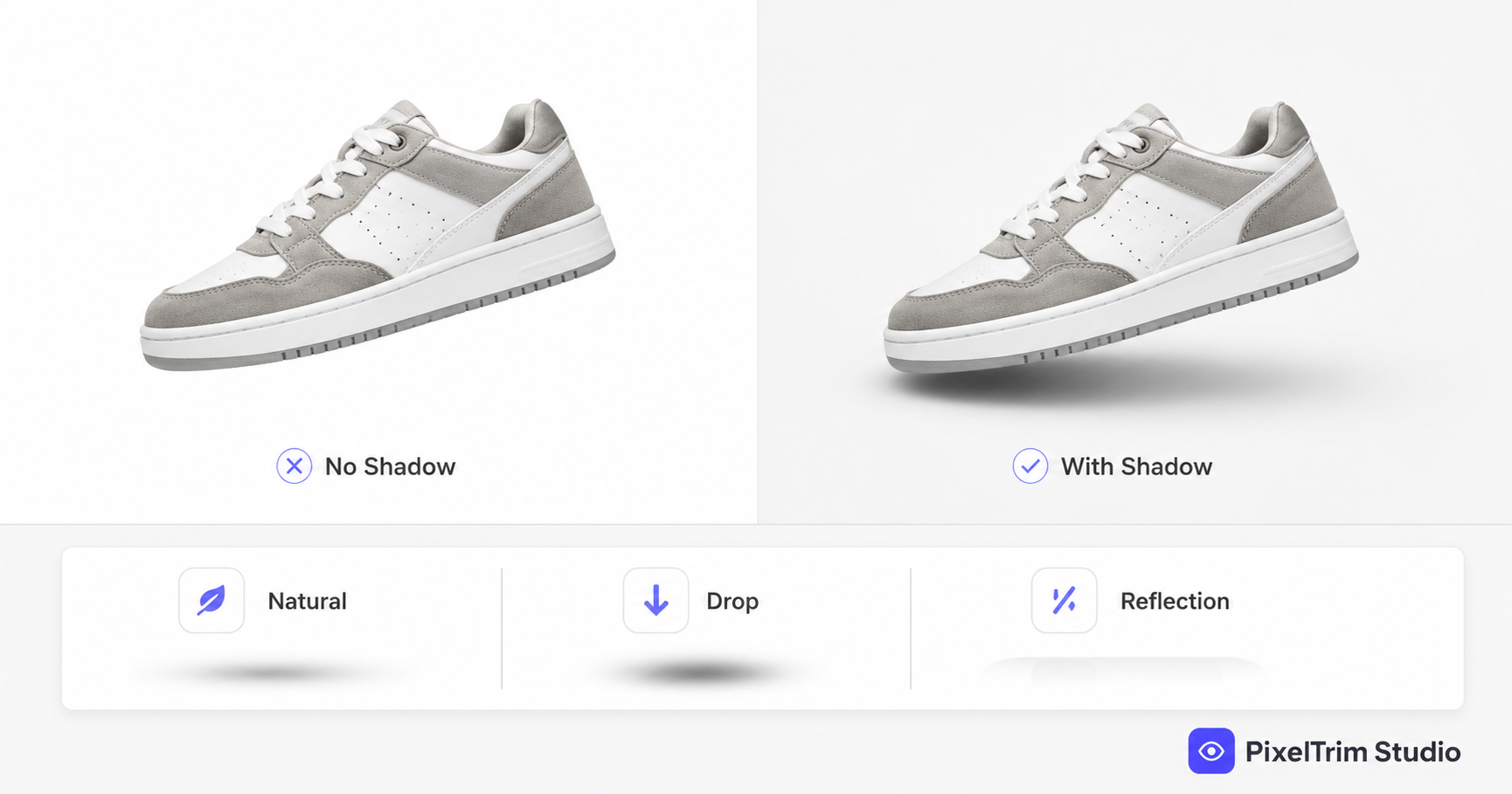
A cut-out product with no shadow looks like it's floating on the page — buyers notice this even if they can't say why a listing feels "off." Shadow creation service is the fix: an editor adds a natural, drop, or reflection shadow so the product looks grounded, without you needing a lightbox, tripod setup, or Photoshop skills. Here's exactly what's included, what it costs, and how to pick a provider that won't hand you a generic filter result.
What a shadow creation service actually includes
A proper shadow service isn't one button click — it's a manual match between the shadow and your product's real shape, lighting, and platform. Most providers offer three core shadow types (we cover the visual difference in full in our shadow types guide):
- Natural shadow — cleaned-up version of the shadow the product actually cast during the shoot. Most realistic, best for single product pages.
- Drop shadow — a uniform, editor-built shadow placed under the product. Fast, consistent, good for catalog/grid listings.
- Reflection shadow — a mirrored fade under the product, like it's sitting on glass. Common for jewelry, electronics, and footwear.
A good service also matches the shadow's angle, softness, and opacity to your actual lighting instead of pasting the same generic shadow on every image — this is the main gap between manual work and a one-size-fits-all AI filter.
Typical deliverables
- Shadow matched to product shape and geometry, not a flat rectangle
- Works on white, grey, colored, or lifestyle backgrounds
- Delivered in JPG, PNG (transparent background), or layered PSD/TIFF on request
- Can be combined with clipping path in the same order for a fully finished image
- 1 revision round included with most providers
How pricing works
Shadow creation is usually priced per image and per shadow type, since reflection work takes more manual time than a basic drop shadow:
| Shadow type | Typical price/image | Why the price differs |
|---|---|---|
| Drop shadow | $0.49 – $1.00 | Fastest to produce, most standardized |
| Natural shadow | $0.89 – $1.50 | Shape-matched, angle and spread control |
| Reflection shadow | $1.29 – $2.50 | Glass/mirror surface simulation, more manual blending |
These line up with the broader per-service ranges in our product photo editing pricing guide. Most providers also bundle shadow with clipping path at a combined rate if you're ordering both — always ask for the bundle price before quoting each separately.
How to choose a shadow creation provider
Not every "photo editing" vendor does shadow work well — a few things separate a real provider from a generic filter service:
- Ask for a free trial on your own images, not stock samples. Shadow direction and softness need to match your actual lighting, not a demo photo.
- Check if they offer all three shadow types — a provider that only does drop shadow can't help if you need a premium reflection look for jewelry or electronics.
- Confirm marketplace compliance knowledge — Amazon's main image allows no visible shadow at all (see our pure white background guide), while eBay, Etsy, and Shopify generally allow shadows. A provider who doesn't ask which platform you're selling on may deliver the wrong spec.
- Ask about revision policy upfront — shadow angle/opacity is subjective, and a provider without a clear revision round often leads to back-and-forth emails instead of one clean fix.
- Check turnaround for your batch size — 24–48 hours is standard; anything promising instant bulk delivery is likely running an unreviewed AI batch, not manual work.
Manual service vs AI shadow tools
AI shadow tools are fast and cheap, but they default to one generic drop shadow regardless of the product's real geometry or material — flat and noticeably wrong on glass, jewelry, or reflective surfaces. We break this trade-off down fully in our manual vs AI photo editing comparison. For simple, solid-shape products a quick AI pass is fine; for anything premium or listing-critical, manual shadow work pays for itself in fewer mismatched images.
Before you send images to a provider
A few shoot-stage habits make shadow work faster and cheaper on the editing side — covered in more depth in our product photography mistakes guide. The short version: shoot on a plain background, keep lighting consistent across the batch, and avoid strong baked-in shadows if you want a clean natural or reflection shadow added later — removing an old shadow before adding a new one is extra work that most quotes don't include by default.
Getting started
If you're not sure which shadow type fits your listings, our image shadow creation service covers all three types — natural, drop, and reflection — matched manually to your product and platform, with a free 2-image trial before you commit to a batch.
Not sure which shadow style your catalog needs? Get a free sample edit and compare the result on your own images before paying for anything.
FAQ
What's included in a shadow creation service?
Manual matching of shadow type (natural, drop, or reflection) to your product's shape and lighting, delivery in your required file format, and usually one revision round if the angle or opacity needs adjusting.
How much does a shadow creation service cost?
Typically $0.49–$1.00 per image for a drop shadow, $0.89–$1.50 for a natural shadow, and $1.29–$2.50 for a reflection shadow, with volume discounts common past 50–100 images.
Can shadow creation be combined with background removal?
Yes — most sellers order shadow together with clipping path in one job, and providers usually quote a combined per-image rate rather than pricing each separately.
Does Amazon allow shadows on product photos?
Not on the main image — Amazon requires a pure white background with no visible shadow. Shadows are fine on secondary/lifestyle images, and generally allowed on eBay, Etsy, and Shopify listings.
Is AI shadow generation good enough, or do I need a manual service?
AI tools work for simple, solid-shape products where a generic drop shadow looks fine. For jewelry, glass, electronics, or anything premium, a manual service matches the shadow to the real material and lighting instead of applying one template to every image.
Tags
Ready to get your images edited?
Upload 2 photos for a free trial edit — returned in under 24 hours.
Start free trial →