Image for illustration purposes only.
If you've ever gotten three quotes for the same clipping path job and seen three wildly different numbers — $0.20, $1.50, and $8 per image — you're not imagining things. Clipping path pricing isn't standardized, and that's exactly why it confuses so many sellers, photographers, and marketing teams.
This guide breaks down how clipping path pricing actually works, what pushes the cost up or down, and how to tell a fair price from a bad deal, whether you're editing 20 images a month or 20,000. For how this compares to other product categories, see our product photo editing pricing guide.
Table of Contents
- Why Clipping Path Pricing Varies So Much
- Common Pricing Models
- What Actually Drives the Price
- General Price Ranges by Complexity
- In-House vs Freelancer vs Agency
- How to Get Good Value
- Red Flags in Cheap Pricing
- Common Budgeting Mistakes
- FAQs
- Conclusion
Why Clipping Path Pricing Varies So Much
Clipping path isn't one service — it's a spectrum. A plain product on a white background with a straight edge takes a minute or two. A product with fur, glass, mesh fabric, or dozens of loose strands can take twenty times longer. Since most editors and agencies price based on time and skill required, the final number depends heavily on what's actually in the photo, not just how many photos there are.
This is also why per-image pricing charts you see online (including the "starting from $X" numbers many services advertise) rarely tell the full story. They usually reflect the simplest tier, not your specific batch.
Common Pricing Models
Most clipping path providers use one of four structures.
Per-image pricing
You pay per photo, usually tiered by complexity (simple, medium, complex). This is the most common model for eCommerce sellers with ongoing but variable batches.
Hourly pricing
Common with freelance editors or highly custom retouching work where complexity is hard to predict in advance.
Bulk or volume-based pricing
Providers often discount per-image rates once you commit to a monthly volume, since it reduces their sales overhead and gives them predictable work.
Subscription or monthly plans
A flat monthly fee for a set number of images, popular with brands that photograph new products every week and want predictable costs.
None of these is objectively "better" — the right one depends on how consistent your photo volume is.
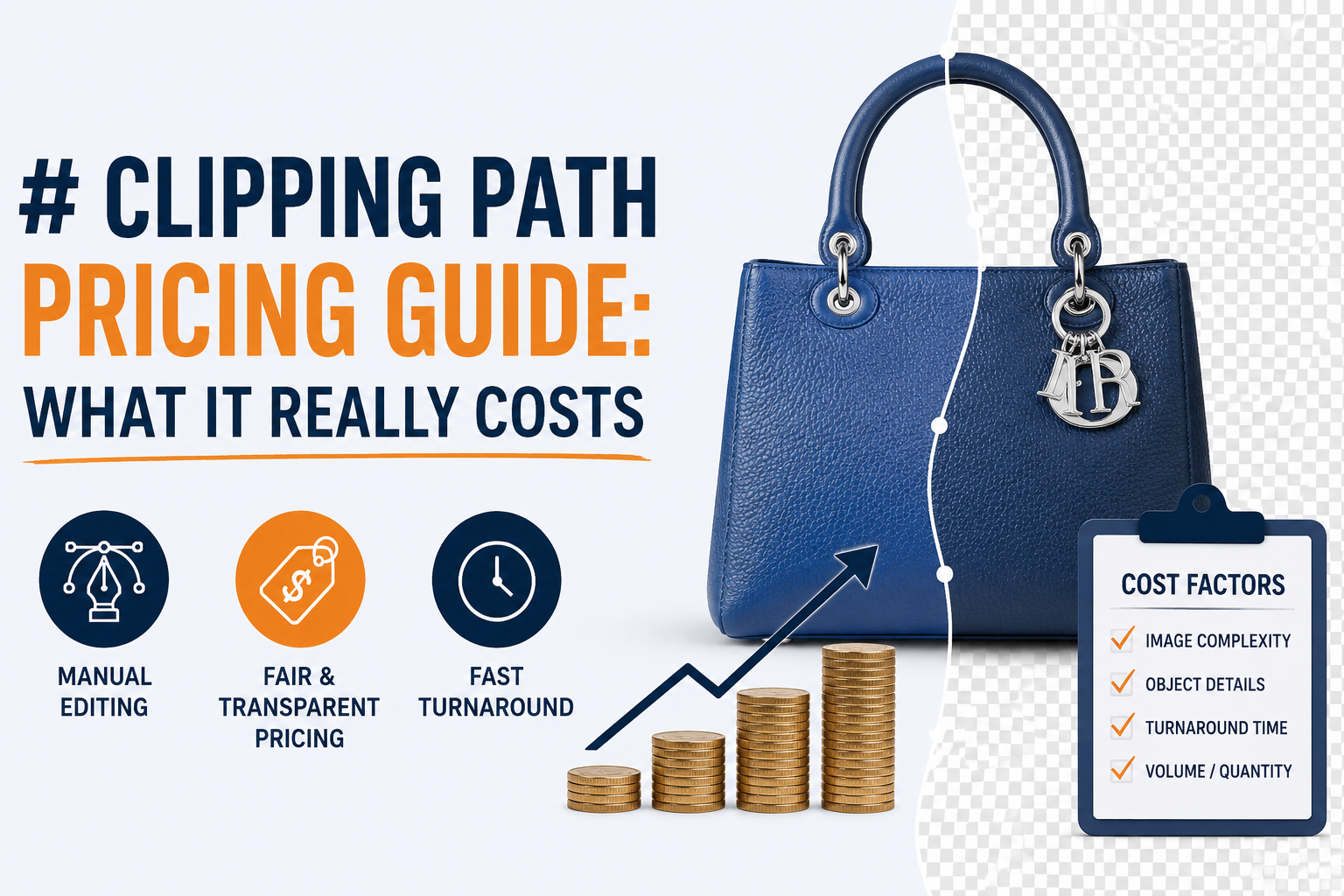
What Actually Drives the Price
Image Complexity
This is the single biggest driver. Editors typically sort work into tiers — see our clipping path types guide for a full breakdown of each:
- Simple — solid product, clean edges, no holes (a bottle, a box, a phone case)
- Medium — some detail work needed (a shoe with laces, a bag with a strap)
- Complex — fine detail, transparency, or multiple embedded paths (jewelry with chain links, a bicycle with spokes)
- Super complex — fur, hair, mesh, glass with reflections, group product shots with many overlapping paths
Turnaround Time
A rush request — same-day or next-morning delivery — almost always costs more than a standard 24-48 hour turnaround, because it forces the provider to reshuffle their queue.
Volume and Consistency
Ordering 50 similar product shots a month is cheaper per image than ordering 5 wildly different one-off images, because batch consistency speeds up editing.
File Requirements
Multiple output formats (PNG with transparency, JPG, layered PSD), specific resolution/DPI needs, or platform-specific formatting (Amazon's pure-white background spec, for example) can add to the base cost.
Who's Doing the Work
An individual freelancer, an in-house editor, and a dedicated agency all price differently — more on that below.
General Price Ranges by Image Complexity
These are commonly cited industry ranges, not fixed rates — always confirm directly with a provider for your specific images.
- Simple images: typically the lowest tier, often under $1 per image at volume
- Medium complexity: usually a noticeably higher per-image rate than simple work
- Complex and super-complex images: priced individually more often than in bulk, since time varies a lot per photo
If a quote doesn't specify which tier your images fall into, ask. A vague flat rate across very different image types is one of the more common sources of billing disputes later.
In-House vs Freelancer vs Agency: Cost Comparison
In-house editor. Highest fixed cost (salary, software, training) but full control over turnaround and quality consistency. Makes sense at high, steady volume.
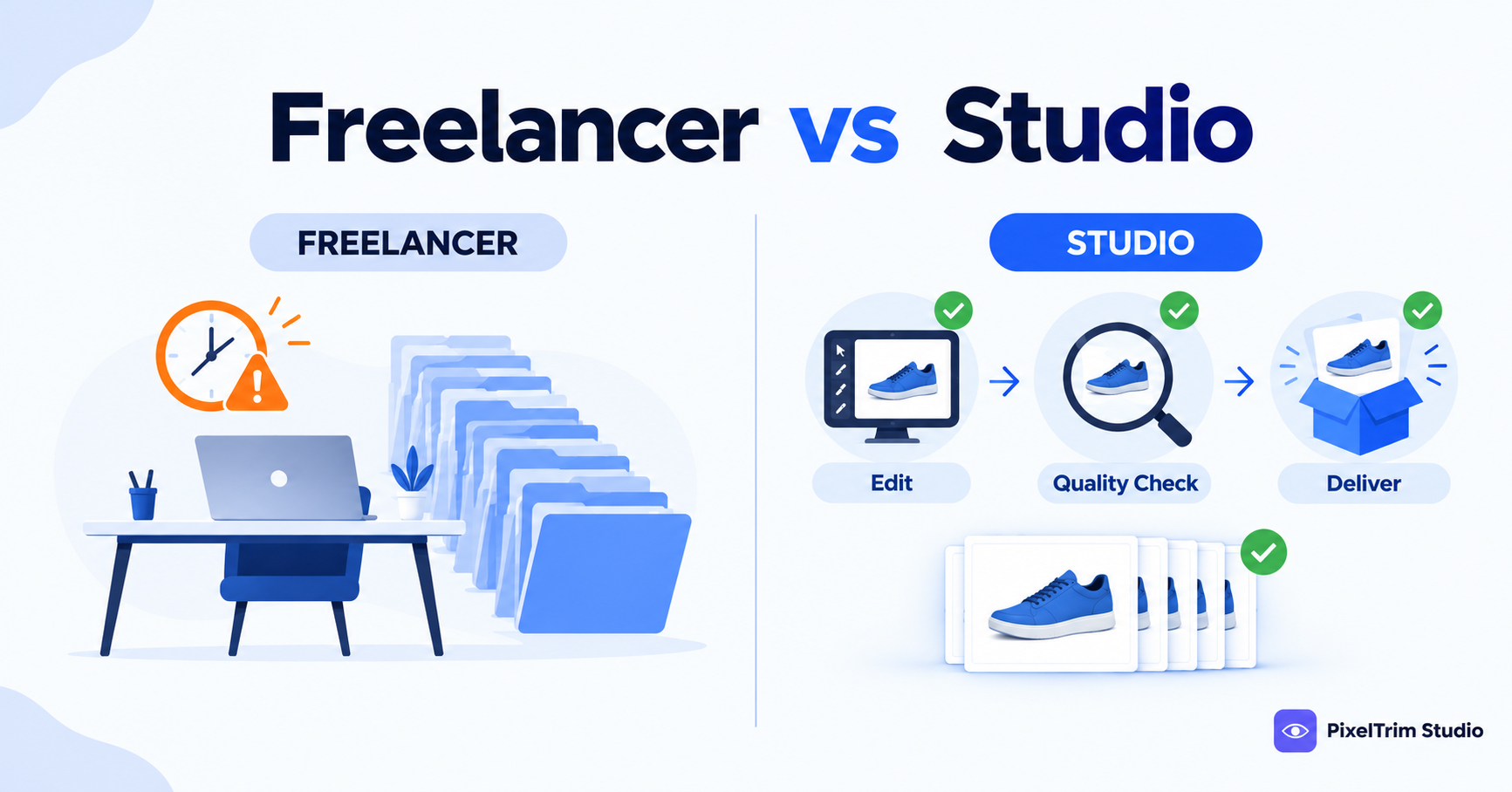
Freelancer. Often the lowest per-image rate, but quality and reliability vary widely, and there's usually no backup if they're unavailable.
Outsourced agency/service. Sits in the middle on price, but typically offers more consistency, revision policies, and dedicated support — useful when you can't afford quality slips (Amazon account health, for instance, is sensitive to inconsistent product images).
How to Get Good Value Without Cutting Corners
- Send a sample batch before committing to a full month's volume — most legitimate providers offer a free trial edit.
- Ask for the complexity tiers in writing so you're not surprised by upcharges later.
- Lock in bulk pricing only after you've confirmed quality on a smaller batch first.
- Clarify revision policy — unlimited revisions vs. a capped number changes the real cost of a "cheap" quote.
Red Flags in Cheap Pricing
Not every low price is a bad deal, but a few patterns are worth watching for:
- Extremely low rates with no visible portfolio or sample work
- No mention of revision policy at all
- Vague file specs ("we'll send you the final image") instead of clear format/resolution commitments
- Pressure to prepay a large volume before any sample work is shown
A slightly higher price with clear samples, clear turnaround times, and a real revision process is usually the better long-term value — redoing a badly edited batch costs more time than it ever saved.
Common Budgeting Mistakes
- Assuming all images cost the same. Mixing simple and complex products in one flat-rate quote often leads to disputes.
- Choosing the cheapest quote without checking sample quality first.
- Not accounting for rush fees when a launch date changes last minute.
- Ignoring revision costs, which can quietly add up if the policy isn't clear upfront.
- Switching providers frequently, which resets consistency and often costs more in re-briefing than it saves in per-image rate.
FAQs
Is clipping path pricing the same everywhere?
No. It varies by provider, region, image complexity, and turnaround time. Always request a quote based on your actual images.
Do bulk orders always get a discount?
Usually, yes — but only if the images are reasonably consistent in complexity. Highly varied batches may not qualify for the lowest bulk tier.
Why did my quote go up after I sent sample images?
Most providers give a general estimate first, then confirm the real price after seeing actual complexity. This is normal and worth expecting.
Is per-image or subscription pricing better for a small store?
Per-image usually suits stores with irregular photo volume. Subscriptions work better once you have a predictable, recurring number of new product shots each month.
Does rush delivery always cost extra?
In most cases, yes. Standard turnaround (24-48 hours) is typically the base rate; same-day or next-morning requests are usually priced higher.
Can AI background removal replace clipping path pricing concerns entirely?
Not for every image. AI tools are often cheaper or free for simple cutouts, but still struggle with fine detail like fur, hair, or transparent materials — see our Manual Clipping Path vs AI Background Removal comparison for where each approach actually works.
What's the difference between a "clipping path" and "image masking" cost?
Masking is usually priced higher than simple clipping path, since it handles soft edges (hair, fur, fabric) that a basic path can't. See our Clipping Path vs Image Masking guide for the technical difference.
How do I know if I need multiple clipping paths on one image?
If a product has separate holes or sections (a mug handle, a bracelet chain), you may need multi clipping path work rather than a single basic path — this usually affects the price tier too.
Conclusion
Clipping path pricing isn't confusing because providers are hiding something — it's confusing because the work genuinely varies from image to image. Once you understand the pricing models, the real cost drivers, and where corners tend to get cut, you can compare quotes properly instead of guessing which number is "normal."
The best move before committing to any provider is simple: send a small sample batch, ask for a tiered quote, and confirm the revision policy in writing.
Want a real quote instead of a guess? We'll quote your actual images by complexity tier, not a flat guess.
Tags
Ready to get your images edited?
Upload 2 photos for a free trial edit — returned in under 24 hours.
Start free trial →