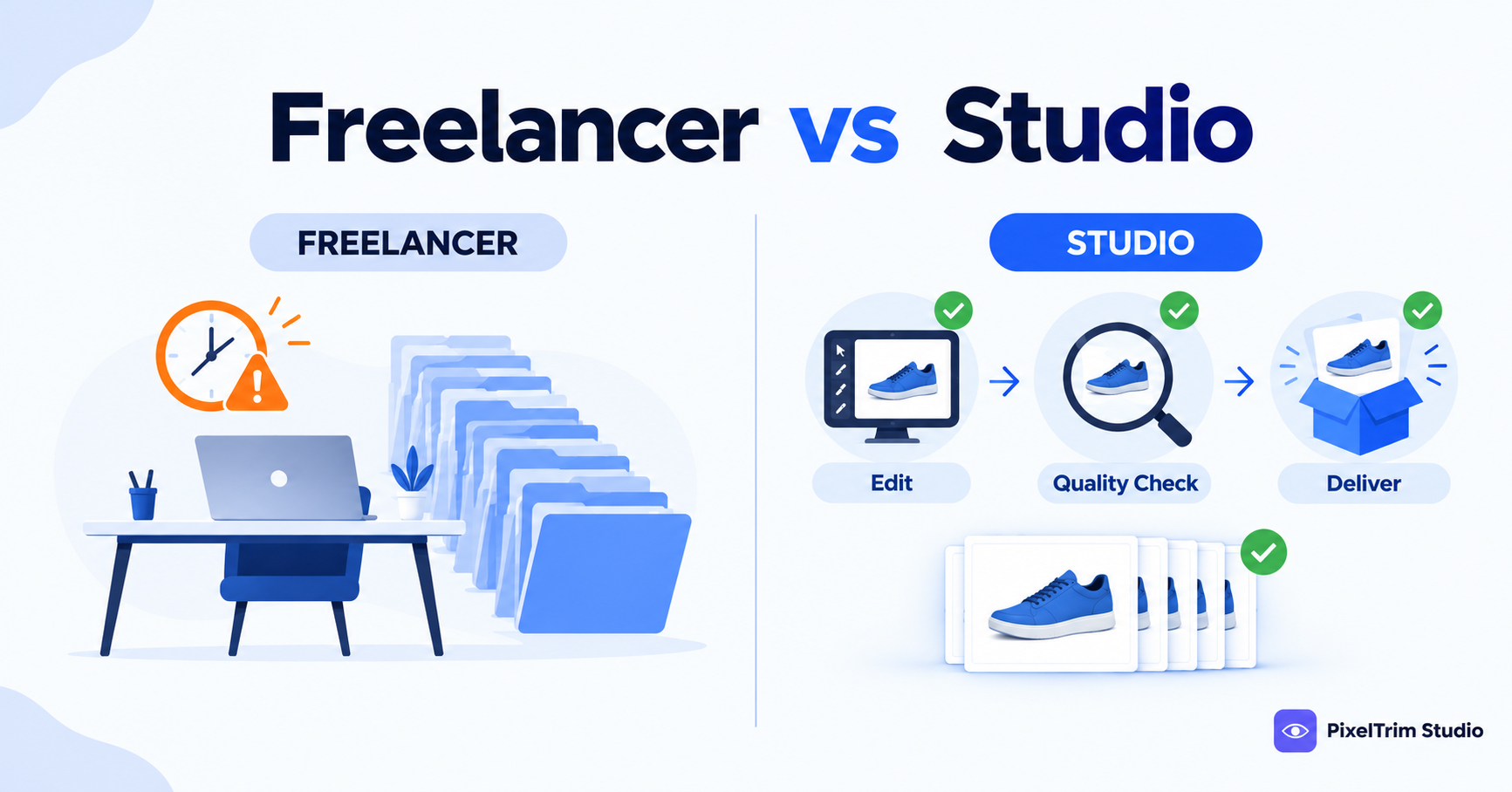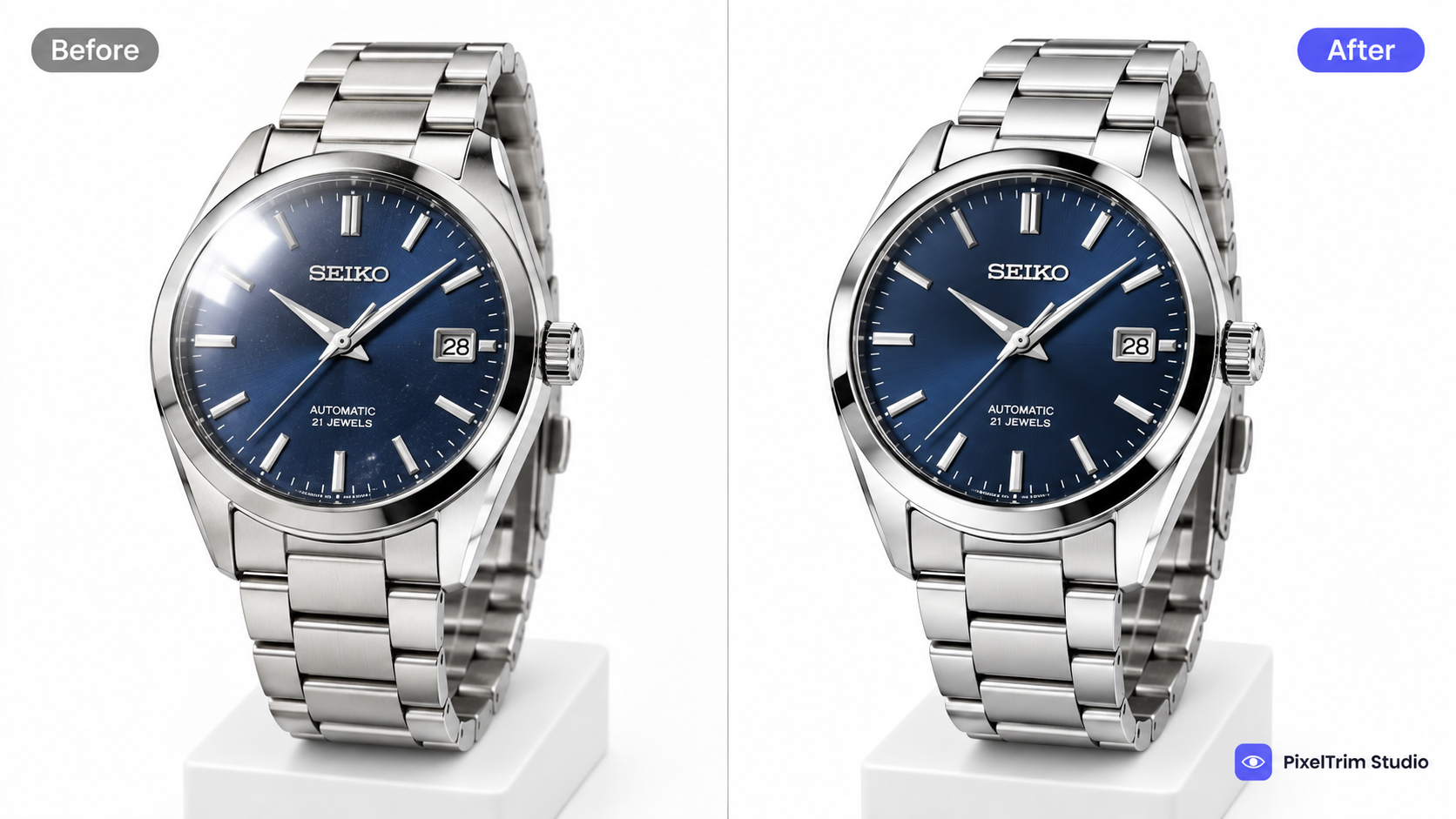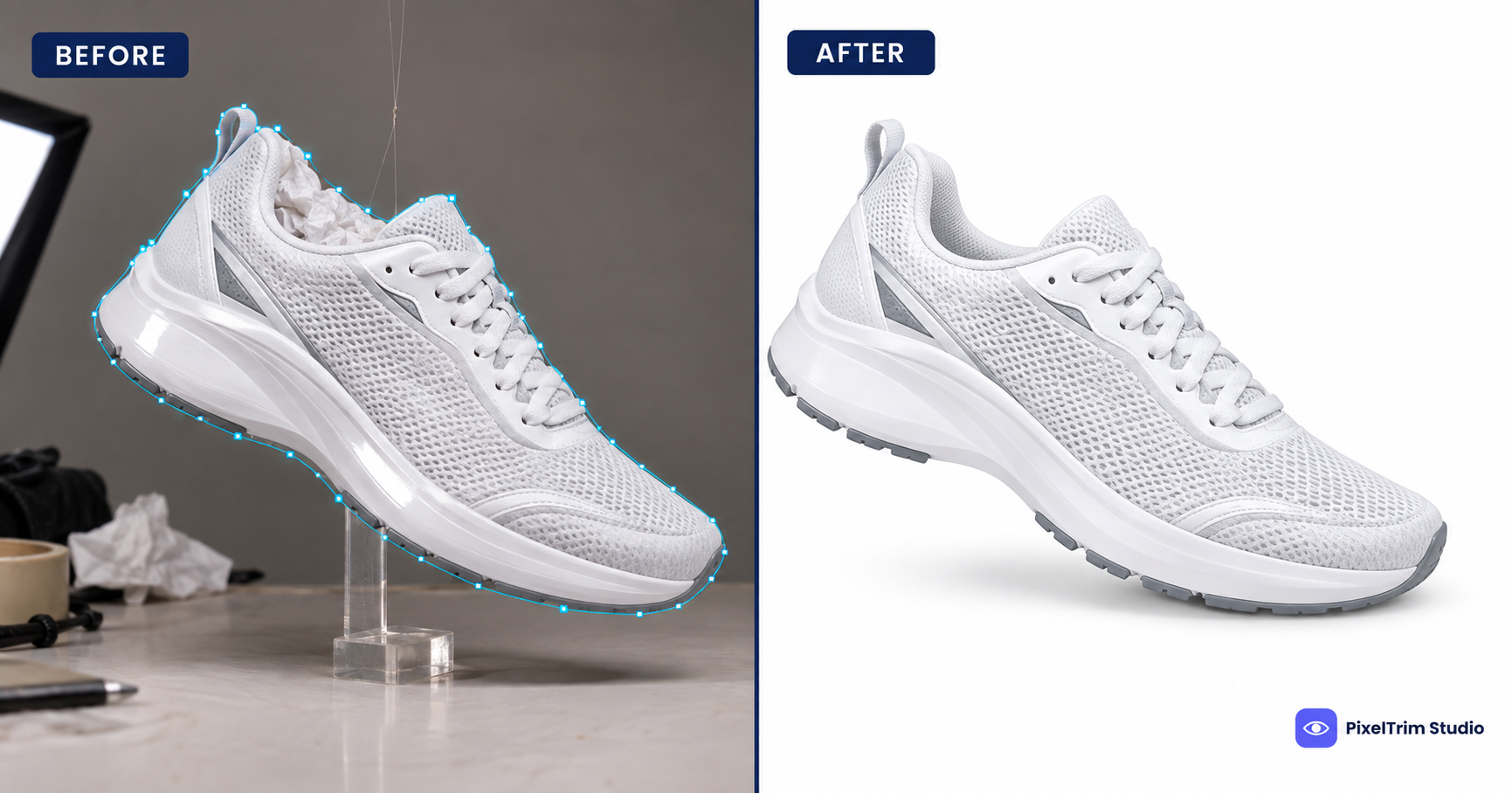
Shoes look simple on a white background, but they are one of the harder product categories to edit well. Laces, eyelets, stitching, mesh uppers, and glossy soles all demand different handling in a single image, and shoppers zoom in on exactly those details before they trust a pair they cannot try on. "Shoe photo editing service" searches keep growing as more footwear brands list on Amazon, Shopify, and Etsy at once, yet most providers still describe the work like it is a plain box on a white background.
This guide breaks down what a proper shoe photo editing service should include, what it actually costs per image, and what to check before you hand a full footwear catalog to a provider. If you are still at the shoot stage, start with our footwear photography tips to lower the editing bill before it starts.
What's Included in a Shoe Photo Editing Service
Shoe editing is not a single step. A complete service covers:
- Clean cutout / clipping path — the shoe isolated with a hand-drawn pen-tool path that holds up around laces, eyelets, heel tabs, and the gaps in open-toe or strappy styles, where automated background removers tend to clip detail or fill in space that should stay transparent.
- Masking for soft edges — mesh, knit, and suede uppers have fuzzy edges a hard vector line flattens. Our guide to what image masking is explains when a mask is needed instead of a path.
- Grounded shadow or reflection — a natural, drop, or reflection shadow under the sole so the shoe reads as resting on a surface instead of floating. See our product photo shadow guide for how each type looks.
- Glare, scuff, and dust cleanup — reducing hot spots on patent and glossy leather without dulling the material's real shine, and removing scuffs, lint, and dust from soles and uppers.
- Support removal — painting out the fishing line, clear stand, foam wedge, or tissue stuffing used to hold the shoe in shape.
- Color matching across colorways — one true-to-life tone for every angle and every color variant, since shoe returns are heavily driven by "this is not the color I ordered."
- Marketplace-ready delivery — output sized and formatted for each platform you sell on, with the same angle set and crop applied across the whole catalog.
A quote that only says "background removal" is usually missing the shadow, cleanup, and color steps that make a shoe look finished rather than pasted.
Where Different Shoe Types Get Difficult
| Shoe Type | Tricky Part | How It Gets Edited |
|---|---|---|
| Sneakers with mesh or knit uppers | Fuzzy, semi-transparent edges | Path for the sole and structure, mask for the mesh edge |
| Patent and glossy leather | Reflections of lights and camera | Manual glare reduction that keeps real shine |
| Sandals, heels, and open-toe styles | Small gaps between straps | Every gap traced individually so the new background shows through |
| Boots | Tall shafts, creases, and shaft openings | Interior lining kept, shape and seams preserved |
Shoe Photo Editing Pricing (2026 Rates)
Shoe editing is typically billed as a clipping path plus a shadow, priced by complexity rather than a flat rate. Here is what PixelTrim Studio currently charges for each piece:
| Service | Tier | Price | Best For |
|---|---|---|---|
| Clipping path | Complex | $0.99/image | Footwear with laces, eyelets, straps, or open framework |
| Clipping path | Medium | $0.69/image | Multi-part shoes with simple outlines |
| Shadow creation | Drop | $0.49/image | Consistent catalog and grid shadow |
| Shadow creation | Natural | $0.89/image | Shape-matched shadow for a realistic studio shot |
| Shadow creation | Reflection | $1.29/image | Glossy-surface look for premium and patent styles |
As a worked example, a complex clipping path plus a drop shadow starts at $1.48 per image, and a five-angle pair comes to about $7.40 before any bundle rate. Clipping path and shadow are usually ordered together and quoted at a combined rate, so ask for the bundle price before you compare quotes. Standard turnaround is 24–48 hours regardless of batch size, with 1 free revision round included.
For how footwear compares with other categories, see our full product photo editing pricing guide and clipping path pricing guide.
What to Look For When Choosing a Provider
Price alone does not tell you whether a provider can handle a footwear catalog. Check for:
- A free sample edit on your own shoe photos, not a stock demo. Mesh, patent, and strappy styles behave very differently, and a sample shows quickly whether a provider can handle yours.
- Manual editing, not AI-only. Automated cutout tools commonly struggle with laces, open-toe gaps, and mesh edges. Our manual vs AI photo editing comparison covers where they fall short.
- Consistency across a full set, not just one hero shot. Ask for a multi-angle sample of the same pair, since mismatched shadow direction or color drift between angles is a common quality gap.
- Bulk workflow experience. A full footwear line can mean hundreds of SKUs at five or six angles each. Our bulk product photo editing guide covers what to expect at that volume.
- Platform-spec awareness. A provider that never asks which marketplace you are delivering to may hand back the wrong size or background for your listings.
Common Red Flags
- A flat per-image rate that does not change between a plain loafer and a strappy sandal
- No shadow or reflection step included or mentioned by default
- No sample or trial offer before a full batch commitment
- No question about which marketplace the images are going to
Selling several categories at once? Our furniture photo editing service guide shows how the same clipping path and shadow approach scales to larger, irregular products.
Get Started
Need your footwear catalog cut out, shadowed, and marketplace-ready? PixelTrim Studio's clipping path service and shadow creation service are 100% manual, priced by complexity, with a free 2-image trial before you commit to a batch. For a full line, contact PixelTrim Studio for a straightforward quote based on your actual pairs.
FAQ
What does a shoe photo editing service typically include?
A hand-drawn clipping path around the shoe, a grounded natural, drop or reflection shadow, glare and scuff cleanup, removal of stuffing, strings and stands, color matching across colorways, and delivery sized to your marketplace spec.
How much does shoe photo editing cost?
Footwear falls in the complex clipping path tier at $0.99 per image, plus $0.49 for a drop shadow, $0.89 for a natural shadow, or $1.29 for a reflection shadow. A shoe with a drop shadow starts around $1.48 per image before any bundle rate.
Why is shoe photo editing harder than editing a simple product?
Shoes combine laces, eyelets, and stitching that need a tight path, mesh or knit uppers with fuzzy edges, and glossy soles that reflect the studio. Each of those adds manual editing time compared with a solid-shape product.
Do shoe photos need a shadow after the background is removed?
Yes, for almost every cutout on a white or colored background. Without a shadow or reflection the shoe looks like it is floating, which is the most common reason a footwear cutout looks obviously edited.
Can AI tools handle shoe background removal?
They can handle simple, high-contrast shots, but they commonly clip laces, fill gaps at the heel and open-toe openings, or leave halos around mesh uppers. Manual editing is safer when the images are going onto a marketplace listing or into a print catalog.
Tags
Ready to get your images edited?
Upload 2 photos for a free trial edit — returned in under 24 hours.
Start free trial →